Software Comparison and Reviews: A Simple Way to Choose Better Software
Introduction
Picking software can become confusing very quickly. Many products solve similar problems and use similar words to describe their features. A closer look often shows major differences in cost, ease of use, security, support, and integrations.
Software comparison gives buyers a simple way to study those differences. Software reviews add useful context about how products work and where they may fit.
The right process does not start with a popular product. It starts with your own needs. This guide explains how to discover software, compare options, review AI tools, check business products, understand total costs, and make a careful buying decision. BestAIToolix can also help users explore software categories and research available options.
First Decide What You Need
Before opening a software directory, define your goal. Ask what problem you want the software to solve.
Write down the main task. Then list the features you need to complete that task. Separate essential features from optional ones.
Next, decide how much you can spend. Consider your team size, data needs, integrations, security requirements, and expected growth.
This simple preparation can remove many unsuitable products before you spend time comparing them.
For example, a small team may only need basic project tracking. A large company may need advanced permissions, reporting, and administration.
Why Software Comparison Matters
Software comparison creates a common method for reviewing different products. Instead of judging each tool by different standards, you examine them using the same questions.
This approach makes product research easier. It can also reveal hidden differences that feature lists may not show.
A product with many features may feel difficult to use. Another product may offer fewer features but match your workflow better.
The goal is not to find a universal winner. The goal is to identify software that fits your specific needs.
Build Your Own Evaluation Scorecard
You do not need a complex scoring system. A simple list of questions can guide your research.
Consider the following factors:
| Area | What to Check | Why It Helps |
|---|---|---|
| Purpose | Does the product solve your main problem? | Confirms basic fit |
| Features | Does it include required functions? | Shows practical value |
| Usability | Can users learn it easily? | Supports adoption |
| Price | What will the team actually pay? | Supports budgeting |
| Security | What controls protect information? | Helps manage risk |
| Privacy | How does the product handle data? | Supports data decisions |
| Integrations | Does it connect with current tools? | Reduces manual work |
| Support | What help can users receive? | Helps solve issues |
| Scalability | Can it support future growth? | Supports long-term use |
| Contracts | What commitments apply? | Reduces buying surprises |
Use the same questions for each shortlisted product. This keeps your research organized.
Understand the Value of Software Reviews
Software reviews can explain a product beyond its marketing material. They may discuss common uses, strengths, limitations, pricing, usability, and important considerations.
Still, readers should understand where review information comes from.
A vendor can explain its own features. Documentation can explain technical functions. User reviews can describe personal experiences. Product testing can show how a tool handles a specific task.
Independent software reviews can bring these details together. Strong reviews explain their criteria and avoid presenting opinions as facts.
Separate Facts From Opinions
Good software research uses clear labels for different types of information.
A product page can confirm that a feature exists. A pricing page can explain a listed plan. Documentation can explain technical behavior.
An opinion may describe whether the interface feels easy. A test may show how well a product handles one task. User feedback may reveal a common experience.
These are different forms of evidence. Treating them separately helps readers understand what they can verify.
Never guess when important information remains unclear.
Use a Software Directory for Discovery
A software directory can shorten the first part of your search. It groups products into categories so users can find relevant tools faster.
You may find categories for cloud software, cybersecurity, project management, databases, developer tools, marketing, finance, HR, observability, and business operations.
Start with the category that matches your problem. Browse several products and note the ones that meet your basic requirements.
Then move from discovery to deeper research. A directory helps you find options, but it should not replace product verification.
AI Tools Need Their Own Comparison Process
AI tools now cover many tasks. These include writing, coding, research, design, data analysis, customer support, and automation.
An AI tools directory can help users discover products by category or task. However, similar names do not mean similar results.
When you compare AI tools, focus on the job you want them to perform. Test similar tasks when possible.
You should also review limits, pricing, integrations, data handling, and security. Business users may need team controls, permissions, and administration features.
A Practical AI Tool Review
Start with the use case. Then compare:
Output quality
Ease of use
Response or processing limits
Pricing
Integrations
API access
Customization
Data handling
Privacy controls
Security information
Team features
Support options
Testing the same task across tools can provide a clearer comparison.
“Best” Depends on the User
Searches for the best AI tools or best software tools often suggest that one product should work for everyone.
Software rarely works that way.
A small company may value simplicity. A developer may care about APIs. A large business may need strong administration. A marketing team may care more about automation.
So, define what “best” means for your own situation. Then compare products against those requirements.
Business Software Needs More Than Feature Research
Businesses often depend on software across several teams. That makes software selection more important than a simple feature comparison.
A business software comparison should cover users, pricing, administration, security, privacy, integrations, automation, reporting, support, scalability, and contracts.
Think about how the software will fit into daily work. Consider how employees will use it, how managers will control access, and how the company will handle its data.
Future growth also matters. A product that works for ten users may need a different plan for one hundred users.
Review the Full Buying Cost
The first price you see may not show the full expense.
Software vendors can use different pricing models. Some charge per user. Others charge by usage, storage, features, or business size.
Additional costs may include:
Setup
Implementation
Training
Premium features
API usage
Extra storage
Support
Additional users
Data migration
Staff time also has value. A complex product may require more training and administration.
Compare the expected total cost, not only the entry price.
Check Data, Security, and Privacy
Software can store important information. Buyers should understand how the product protects and handles that data.
Review authentication, permissions, access controls, encryption, storage, and retention policies. Check how the vendor collects and uses information.
Also find out whether users can export their data. This can matter when a company changes products later.
Businesses may have specific compliance needs. Verify those requirements using reliable evidence. Never assume that a product meets them without checking.
Make Sure Your Tools Can Work Together
A new software product rarely works alone. Most teams already use several other tools.
Check whether the new product connects with your current systems. These may include CRM software, databases, cloud services, communication platforms, identity systems, analytics tools, or developer tools.
APIs can also matter when your team needs custom connections.
Poor compatibility can create extra manual work. Review integrations before you commit to a product.
How to Judge Independent Software Reviews
Independent software reviews can help users understand products from a wider perspective. But the quality of a review depends on its research method.
Look for reviews that explain their evaluation criteria. Check whether they support important claims with evidence.
A useful review should discuss both useful features and limitations. It should also separate factual information from editorial opinions.
Readers should know when a reviewer has a commercial relationship with a vendor. Clear disclosure adds useful context.
No single review can answer every buyer's question. Use several reliable sources when the decision matters.
Common Mistakes Buyers Should Avoid
Choosing a Product Because It Is Popular
Popularity does not automatically mean good product fit. Compare it with your requirements.
Looking Only at Price
A low starting price may hide important limitations. Review the complete cost.
Ignoring Usage Growth
User numbers and data volumes can increase. Check future pricing and limits.
Reading Only One Review
Different reviews may cover different experiences. Compare information from multiple sources.
Skipping a Trial
A feature list cannot show every part of the user experience. Test key workflows.
Forgetting Data Privacy
Check what data the product collects and how it handles that information.
Missing Integration Limits
A product may look useful but create extra work without the right connections.
Buying Unused Features
Extra features can add cost and complexity. Focus on the functions your team needs.
Ignoring Contract Details
Read renewal, cancellation, minimum-term, and user-limit rules.
Assuming AI Tools Are Interchangeable
Different AI products can produce different results. Compare them using real tasks.
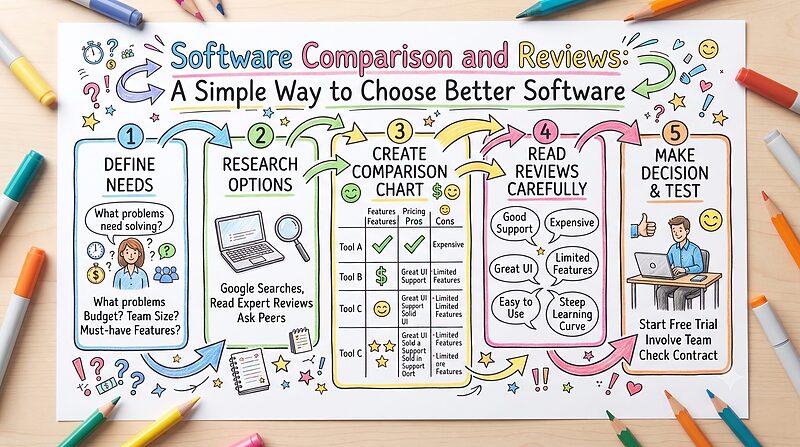
A Simple Software Buying Method
You can turn the entire research process into nine steps:
Define → Discover → Filter → Shortlist → Compare → Verify → Test → Calculate → Decide
Define: Identify the problem.
Discover: Search directories and relevant software categories.
Filter: Remove tools that miss essential requirements.
Shortlist: Keep a manageable group of suitable products.
Compare: Review features, price, security, privacy, and integrations.
Verify: Check important claims against reliable information.
Test: Use trials or practical tests when available.
Calculate: Review the expected total cost.
Decide: Select the product that matches your requirements.
This method keeps the process clear without making it complicated.
Practical Examples of Software Evaluation
Choosing Software for Project Work
A small business may need task management, collaboration, deadlines, and basic reports.
The team can compare ease of use, user pricing, integrations, and support. It may not need complex enterprise features.
Comparing AI Tools for Coding
A developer may need coding help, integrations, API access, usage limits, and privacy controls.
Testing similar coding tasks can show useful differences between products.
Selecting Marketing Software
A marketing team may need automation, campaign management, reporting, and customer data connections.
The team should check how pricing changes as contacts and usage grow.
Reviewing IT Security Software
An IT team may focus on monitoring, alerts, access controls, reporting, integrations, and support.
The team should verify technical claims through reliable documentation before deployment.
How BestAIToolix Can Help
BestAIToolix can support the software discovery and research process. Users can explore software categories, product information, reviews, comparison topics, and buying resources.
The platform can also help users research AI tools and compare options based on different use cases.
This type of resource works best as part of a larger evaluation process. Users should still verify important product information before making a purchase.
FAQs About Software Comparison and Reviews
What is software comparison?
Software comparison means reviewing multiple products using common criteria. Buyers can compare features, price, security, privacy, integrations, usability, support, and scalability. This process makes product differences easier to understand. It also helps users find software that fits their specific needs instead of choosing a product based only on popularity.
What should I check in software reviews?
Look for information about features, pricing, usability, limitations, integrations, and support. Check how the reviewer collected the information. Reliable reviews should separate facts from opinions. Product documentation, public pricing, testing, and user feedback can provide useful evidence for different parts of the review.
How do I find the right software tool?
Begin with your main business or personal problem. List the features you must have and set a budget. Search relevant categories and create a shortlist. Compare the shortlisted products using the same criteria. Test suitable options when possible before making your final decision.
What is a software directory?
A software directory organizes products by category, purpose, or use case. It helps users discover tools more easily. Directories can cover business software, cloud tools, cybersecurity, development, marketing, finance, HR, and other areas. Users should verify important product information before buying.
What is an AI tools directory?
An AI tools directory collects AI products into useful categories. Users can search for tools based on tasks such as coding, writing, research, design, or data work. It makes discovery easier. Buyers should still compare capabilities, limits, pricing, privacy, and security before choosing a tool.
How can I compare AI tools?
Start with one clear task. Test each product using similar requirements. Compare output quality, ease of use, pricing, usage limits, integrations, API options, and customization. Also review privacy and data handling. Business users should check security and administration controls before wider use.
What does “best AI tool” really mean?
The phrase depends on the user's goal. Different AI tools support different tasks. One may work well for coding, while another may support research or design. The best fit depends on required features, budget, workflow, privacy needs, and expected results.
How can businesses compare software?
Businesses should compare features, user limits, pricing, administration, security, privacy, integrations, automation, reporting, support, and scalability. Contract terms also matter. Teams should calculate total costs and consider future growth. A practical test can show how well the product fits real business workflows.
What makes a software review independent?
An independent review should use clear criteria and explain its evidence. It should distinguish facts from opinions and mention meaningful limitations. Reviewers should also disclose relevant commercial relationships. A transparent method helps readers understand how the reviewer reached each conclusion.
What should I check before buying software?
Review features, pricing, security, privacy, integrations, support, user limits, scalability, and contract terms. Check how the product handles your data. Test important workflows if possible. Verify major claims through reliable documentation. These steps can reduce surprises after purchase.
Why should I compare total software costs?
The advertised price may cover only basic use. Extra users, storage, API calls, training, setup, support, or advanced features can increase spending. Comparing total costs gives buyers a clearer budget view. It also makes product comparisons more useful over the expected period of use.
How can a software buying guide help me?
A software buying guide gives buyers a clear path for research. It explains what to compare and which questions to ask. It can also highlight common buying mistakes. Following a structured guide helps users evaluate products based on needs, evidence, cost, and long-term fit.
Final Thoughts
Choosing software becomes easier when you know what you need before you start searching. A clear goal helps you avoid products that offer features you will never use.
Use software comparison to study products on common factors. Read software reviews carefully and look for evidence. Explore a software directory when you need discovery help. Use an AI tools directory when you need to find tools for specific tasks.
Before buying, check pricing, total cost, security, privacy, integrations, support, and future growth. Test important products whenever possible.
BestAIToolix can support the discovery and research stages of this process. Your final choice should come from your own requirements, budget, workflow, and users.