How Japanese Technology Teams Can Build Stronger DevOps Skills
Introduction
A modern technology team has many jobs to handle. It must build software, manage infrastructure, protect systems, and keep services running. It must also respond to changes without making daily work harder.
DevOps gives teams a way to connect these tasks. It combines development, operations, automation, security, and reliability into one working approach.
But DevOps does not start with a tool. It starts with people who understand the work and know how to improve it.
That is why training and consulting matter. DevOps training builds practical skills. Consulting helps teams solve problems in their own environments. Technical support helps them keep systems running after changes.
DevOpsSchool.jp supports these areas for organizations working with modern technology in Japan. Its focus includes DevOps, Kubernetes, Terraform, SRE, DevSecOps, MLOps, cloud systems, and automation.
Start With a Clear Technical Goal
Before choosing a course or consultant, define the problem.
A team may struggle with slow releases. Another team may manage cloud resources manually. A production group may have too many alerts.
These situations need different skills.
| Team Need | Useful Area |
|---|---|
| Better software delivery | DevOps |
| Container operations | Kubernetes |
| Infrastructure automation | Terraform |
| Production reliability | SRE |
| Security in delivery | DevSecOps |
| Machine learning operations | MLOps |
This simple comparison can help teams avoid unnecessary training.
DevOps Connects the Full Delivery Process
DevOps brings development and operations closer together.
Instead of treating software development and system operations as separate jobs, teams share responsibility for delivery and reliability.
A DevOps process may include:
Source control
Automated testing
CI/CD
Infrastructure as code
Cloud management
Monitoring
Security checks
Incident response
Automation
Team collaboration
DevOps includes CI/CD, but the two terms do not mean the same thing.
CI/CD mainly automates software build, test, and delivery tasks. DevOps also covers culture, processes, operations, infrastructure, security, and feedback.
The difference matters when a company plans its training or consulting work.
DevOps 研修 Builds a Common Skill Base
DevOps 研修 gives teams a structured way to learn modern engineering practices.
A course may introduce Git, CI/CD, containers, cloud services, automation, testing, monitoring, and deployment.
Technical learning works better when people practice.
For example, learners can create a small pipeline. They can test code, automate a deployment, and review the result.
These exercises make abstract ideas easier to understand.
Team-based training can also help employees use the same terms and processes. This can improve communication between developers, operations engineers, and technical managers.
What Makes DevOps Training Useful?
A useful course should match the team's actual work.
Companies should consider:
Employee experience
Technical roles
Current tools
Existing systems
Learning goals
Practical exercises
Future projects
A beginner may need basic Git and CI/CD skills. An experienced platform engineer may need advanced Kubernetes or infrastructure work.
The same course does not suit every team.
DevOps コンサルティング Helps With Real Systems
Training teaches concepts. DevOps コンサルティング focuses on applying them.
A consultant can review a company's existing setup. The review may cover pipelines, cloud infrastructure, automation, monitoring, security, or reliability.
The consultant can then help the team identify useful changes.
For example, a company may have a working CI/CD pipeline but still rely on manual infrastructure changes. The team could focus its next improvement on infrastructure as code.
Consulting should solve a defined problem. It should not introduce tools simply because they are available.
Training and Consulting: A Simple Comparison
| Area | Training Focus | Consulting Focus |
|---|---|---|
| DevOps | Delivery and automation skills | Delivery process improvement |
| Kubernetes | Container management | Platform design and operations |
| Terraform | Infrastructure as code | Infrastructure automation |
| SRE | Reliability practices | Production reliability |
| DevSecOps | Security skills | Secure engineering workflows |
| MLOps | ML operations skills | ML system processes |
Training develops people. Consulting supports technical decisions and implementation.
Many organizations can use both at different stages.
Kubernetes 研修 for Container-Based Systems
Kubernetes helps teams manage container workloads.
Kubernetes 研修 can introduce pods, deployments, services, configuration, storage, networking, scaling, and monitoring.
Training should also include troubleshooting. Engineers need to know what happens when applications fail, resources become limited, or configurations cause problems.
Kubernetes and Docker have different roles.
Docker helps teams build and run containers. Kubernetes manages container workloads across machines.
Understanding this difference can help teams plan their learning path.
Terraform 研修 for Infrastructure Automation
Terraform 研修 teaches engineers to describe infrastructure with code.
Instead of creating every resource manually, teams define infrastructure in configuration files.
Training may cover:
Providers
Resources
Variables
Outputs
Modules
State
Planning
Applying changes
Terraform mainly manages infrastructure resources.
Configuration management tools often focus on software and settings inside machines.
Teams may use both approaches when their environment needs them.
SRE 研修 for Reliable Services
SRE stands for Site Reliability Engineering.
SRE 研修 teaches teams how to manage reliability with clear methods and measurements.
Topics may include:
Service level indicators
Service level objectives
Error budgets
Monitoring
Alerting
Incident response
Automation
SRE shares many ideas with DevOps.
DevOps covers the wider software delivery and operations model. SRE puts stronger focus on keeping production services reliable.
Teams can use both approaches together.
DevSecOps 研修 for Secure Delivery
Security needs to follow software throughout its lifecycle.
DevSecOps places security inside development and delivery work.
DevSecOps 研修 may include secure coding, dependency checks, secrets, access control, container security, and automated security tests.
The goal is to make security part of normal engineering work.
Developers can learn basic security practices. Operations teams can manage secure infrastructure. Security teams can work with both groups earlier.
MLOps 研修 for Machine Learning Systems
Machine learning systems create extra operational work.
Teams need to manage models, data, experiments, versions, deployment, and monitoring.
MLOps organizes these activities.
MLOps 研修 can cover model pipelines, model deployment, model versioning, monitoring, automation, and data workflows.
MLOps follows many DevOps principles. It also adds practices that address the special needs of machine learning systems.
The Main Training Paths
| Training Area | Main Skills | Typical Use |
|---|---|---|
| DevOps | CI/CD, automation, teamwork | Software delivery |
| Kubernetes | Containers, orchestration, scaling | Container platforms |
| Terraform | Infrastructure as code | Cloud infrastructure |
| SRE | Monitoring, reliability, incidents | Production systems |
| DevSecOps | Security, testing, access | Secure delivery |
| MLOps | Models, pipelines, monitoring | ML operations |
DevOps Corporate Training Japan
DevOps corporate training Japan can help companies build skills across an internal team.
A company can select topics based on its projects.
Developers may study CI/CD. Cloud engineers may focus on Kubernetes and Terraform. Operations teams may need SRE and monitoring skills.
Corporate training can also use examples that reflect internal workflows.
Managers should define the desired learning outcome before the course starts.
This gives trainers a clear target and helps employees connect learning with their daily tasks.
DevOps Consultant Japan: Choosing the Right Partner
A DevOps consultant Japan service can support organizations during technical changes.
Before selecting a consultant, companies should ask:
What technical problem will the consultant solve?
What experience matches the project?
How will the consultant review the current system?
How will the team receive documentation?
How will internal engineers learn from the work?
What support will remain after implementation?
Technical knowledge matters, but communication matters too.
The consultant should explain technical choices in language that the internal team can understand.
DevOps Support Japan for Ongoing Work
Implementation does not always end the technical challenge.
Teams may need help after a new pipeline, cloud system, or platform goes live.
DevOps support Japan may cover:
CI/CD troubleshooting
Cloud infrastructure
Kubernetes operations
Terraform issues
Monitoring
Automation
Reliability work
Companies should define support responsibilities clearly.
Internal engineers should still own important systems whenever possible.
A Practical Selection Method
Companies can use five steps.
Step 1: Describe the Problem
Write the issue in simple words.
Step 2: Find the Skill Gap
Decide what employees need to learn.
Step 3: Choose Training or Consulting
Use training for skill building. Use consulting for specific technical problems.
Step 4: Start Small
Test new practices with a manageable project.
Step 5: Review the Results
Check what improved and what still needs work.
This process keeps DevOps work focused.
Twelve Problems Teams Should Avoid
1. Starting With a Tool
Define the problem before selecting technology.
2. Ignoring Existing Skills
Course difficulty should match the learners.
3. Treating DevOps as a Single Product
DevOps describes a way of working, not one product.
4. Focusing Only on Speed
Reliable and secure delivery also matters.
5. Leaving Security Until Release
Security should appear throughout the delivery process.
6. Adding Too Many Tools
Extra tools create extra learning and maintenance work.
7. Skipping Practice
Technical skills need hands-on learning.
8. Ignoring Monitoring
Teams need useful system information.
9. Making Large Changes at Once
Small changes are easier to test.
10. Copying Another Organization
A solution should match the company's environment.
11. Removing Internal Engineers From Decisions
Employees need ownership and understanding.
12. Stopping After Implementation
Teams should keep reviewing and improving their work.
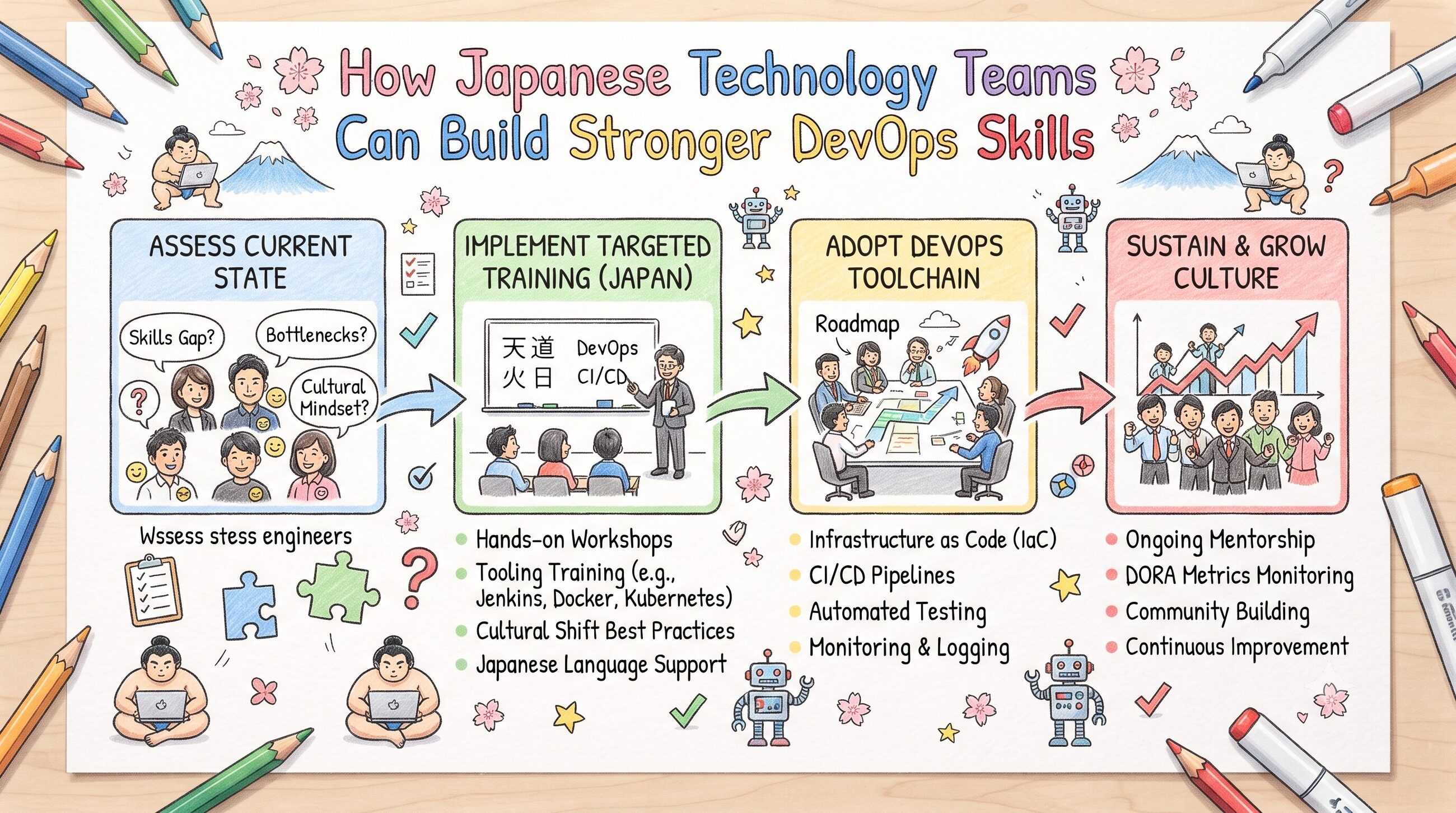
A Simple DevOps Adoption Cycle
A practical cycle can look like this:
Understand → Plan → Train → Practice → Implement → Measure → Improve → Support
Understand: Review systems, processes, skills, and problems.
Plan: Select clear goals and a manageable scope.
Train: Teach the skills needed for the project.
Practice: Test the skills through labs or small projects.
Implement: Apply the useful practices to real work.
Measure: Review delivery, reliability, security, and operations.
Improve: Adjust processes based on what the team learns.
Support: Use specialist help when internal teams need it.
Teams can repeat this cycle as their technology changes.
Realistic Use Cases
A Team With Manual Releases
A Japanese software team may handle releases through several manual steps.
DevOps 研修 can teach the team CI/CD and automation. Engineers can then create a small pipeline for one application.
The team can improve the pipeline after testing it in daily work.
A Company Preparing for Kubernetes
An enterprise may want to move applications into containers.
Engineers can start with Kubernetes 研修. They can learn deployments, services, configuration, scaling, and basic troubleshooting.
Consulting can help the company review its architecture before wider implementation.
A Cloud Team Managing Resources by Hand
A cloud team may create resources manually.
Terraform 研修 can teach infrastructure as code. Engineers can begin with a small environment and learn how Terraform plans and applies changes.
The team can expand its use after gaining practical experience.
A Team Working on Reliability
A production team may receive many alerts without clear priorities.
SRE 研修 can teach reliability measures and incident practices.
Engineers can then review alerts and focus on signals that provide useful information.
How DevOpsSchool.jp Fits Into the Process
DevOpsSchool.jp provides training and technical services for organizations working with modern engineering practices.
Its areas include DevOps, Kubernetes, Terraform, SRE, DevSecOps, MLOps, cloud technologies, automation, and reliability.
Companies can use training to strengthen internal skills. They can use consulting when they need help with specific technical work. Implementation and support can help teams during later stages.
The right combination depends on the team's goals, systems, skills, and project needs.
FAQs About DevOps Training and Consulting
1. What is the main goal of DevOps training?
DevOps training helps employees understand better ways to build, test, release, and operate software. Courses may cover CI/CD, automation, cloud systems, containers, monitoring, and teamwork. Practical exercises can make the lessons easier to apply. Companies should select training that matches employee roles and current technical needs.
2. What can employees learn in DevOps 研修?
DevOps 研修 can teach source control, CI/CD, automation, containers, cloud platforms, testing, monitoring, and delivery practices. The course depth depends on the learners. Beginner programs focus on basic concepts. Advanced programs can cover architecture and production workflows.
3. How does DevOps consulting work?
DevOps consulting starts with an existing technical or process problem. A consultant studies the current environment and identifies possible improvements. The consultant may then help design or implement changes. The internal team should take part in the process and understand the decisions made during the project.
4. What does Kubernetes 研修 teach engineers?
Kubernetes 研修 teaches engineers how to manage container workloads. Topics may include pods, deployments, services, configuration, storage, networking, scaling, and monitoring. Courses may also include troubleshooting exercises. Learners should understand basic container concepts before moving into advanced Kubernetes topics.
5. Why is Terraform 研修 useful?
Terraform 研修 teaches infrastructure as code. Engineers learn how to define resources through configuration files and manage changes through a repeatable process. Training may cover providers, resources, modules, variables, outputs, and state. Practical exercises can help teams understand how Terraform behaves before using it in larger environments.
6. What does SRE 研修 focus on?
SRE 研修 focuses on production reliability. Teams can learn about service indicators, service objectives, monitoring, alerts, incidents, automation, and error budgets. These practices help teams discuss reliability with measurable goals. SRE works alongside DevOps but gives more attention to production service health.
7. What is the purpose of DevSecOps 研修?
DevSecOps 研修 teaches teams how to include security throughout software development and delivery. Topics can include secure coding, dependency checks, secrets, access control, container security, and automated testing. This approach encourages development, operations, and security teams to share responsibility for secure delivery.
8. What does MLOps 研修 cover?
MLOps 研修 covers the operational side of machine learning. Learners may study model versioning, deployment, pipelines, monitoring, automation, and data workflows. MLOps builds on DevOps practices while addressing the needs of models and data. Companies should select topics based on their own machine learning lifecycle.
9. How does DevOps corporate training Japan work?
DevOps corporate training Japan allows companies to train internal teams around shared goals. Organizations can choose topics that match their projects and employee roles. Developers may study CI/CD, while platform teams may study Kubernetes and Terraform. Corporate training can also use examples from the company's technical environment.
10. What should companies check in a DevOps consultant Japan?
Companies should review technical experience, communication, documentation, and knowledge transfer. They should explain the problem clearly and ask how the consultant will study the current environment. Teams should also discuss ownership and support after implementation. Internal engineers should remain involved in important technical decisions.
11. What services can DevOps support Japan include?
DevOps support Japan can include assistance with CI/CD, cloud systems, Kubernetes, Terraform, monitoring, automation, and troubleshooting. The exact scope depends on the service agreement. Companies should define responsibilities, supported systems, request methods, documentation, and escalation processes before work begins.
12. How should organizations combine training and consulting?
Organizations can use training when employees need new skills. They can use consulting when they face a specific technical challenge. A company can also use both. Employees can learn the core concepts first, then work with specialists during implementation. This approach can connect learning with real technical work.
Final Thoughts
Better DevOps work starts with a clear understanding of the team's needs. Companies do not need to adopt every practice or platform at the same time.
A focused training plan can build internal skills. Practical consulting can help teams solve difficult system problems. Ongoing support can help engineers handle new challenges after implementation.
DevOps, Kubernetes, Terraform, SRE, DevSecOps, and MLOps each serve different purposes. The right choice depends on the systems, people, and goals involved.
DevOpsSchool.jp can support this journey through training, consulting, implementation assistance, and technical support. Teams can make steady progress by learning, practicing, measuring, and improving one step at a time.